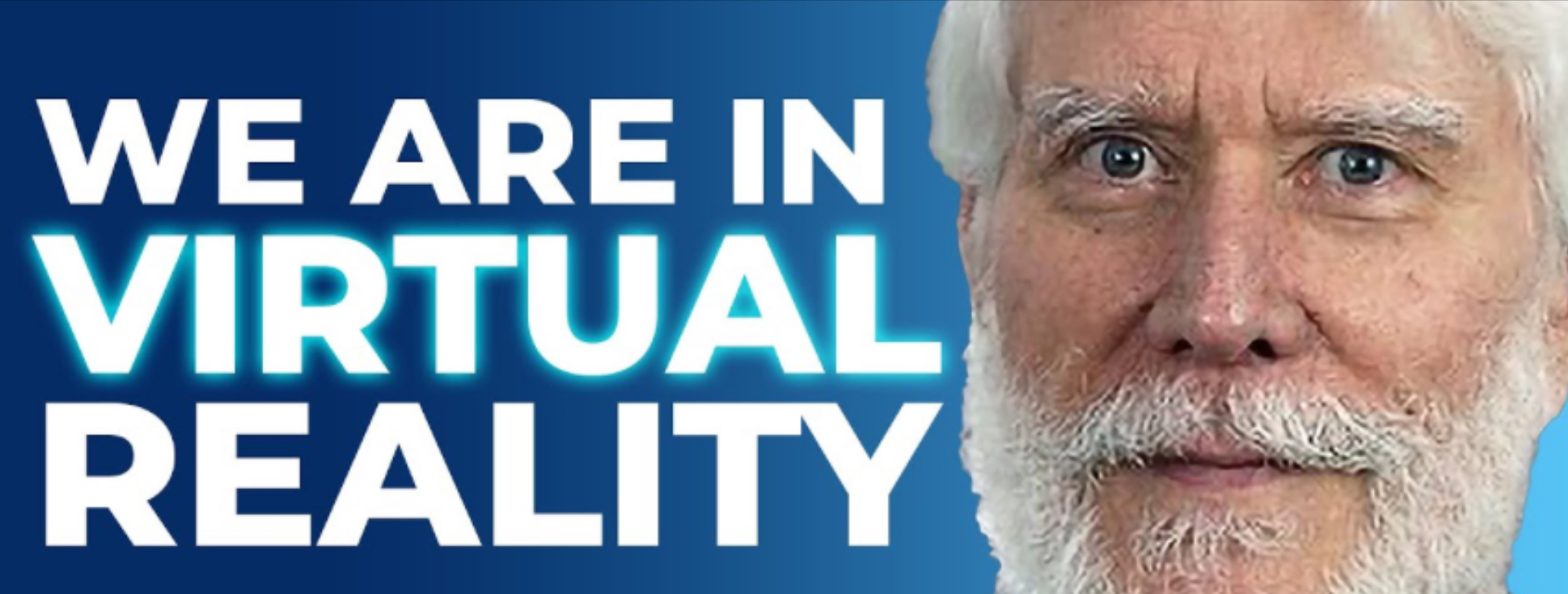
Tom Campbell may not be the first name that comes to mind when discussing mind, body, spirit explorations. But for those diving into the deeper questions of reality, consciousness, and the nature of fear and love, his work—particularly his trilogy, My Big TOE (Theory of Everything)—offers a fascinating and accessible bridge between science and spirituality.
From Rocket Science to Consciousness Research
Tom Campbell’s background is not one of mysticism or speculative philosophy. He is a physicist by training, having earned degrees from both Purdue University and the University of Virginia. He began his professional career working at the U.S. Department of Defense and later became a key player in various NASA projects, particularly those involving large-scale systems simulations and missile defense.
Campbell worked as a senior analyst at NASA, applying his knowledge of physics and mathematics to model and analyze highly complex systems. He wasn't someone you'd expect to dive into metaphysics—but that’s precisely what makes his transition so compelling. He applied the same logic and rigor from his scientific background to the study of consciousness and the nature of reality itself.
The Shift: Meeting Robert Monroe
In the 1970s, Campbell met Robert Monroe, a pioneer in out-of-body research and founder of the Monroe Institute. Monroe was conducting experiments to understand non-physical states of awareness. Campbell, ever the curious scientist, joined him—not as a passive observer but as an active participant and developer of the early lab instrumentation that measured and supported these states.
He began having his own out-of-body experiences (OBEs), not as a spiritual seeker but as an engineer running tests. His approach was to treat the subjective experience of consciousness with the same empirical curiosity that physicists apply to gravity or electromagnetism. Over time, this led to the creation of My Big TOE, which attempts to explain not only the physical universe but also consciousness, time, and the purpose of life—all through a consistent, logic-based model.
My Big TOE: Consciousness is the Key
At the heart of Campbell’s theory is the idea that consciousness is the fundamental “stuff” of reality. The physical world is not primary but emergent. In this model, we are all individuated units of consciousness experiencing a virtual reality, learning and evolving through experience.
The purpose of life, according to Campbell, is to evolve the quality of our consciousness. And the simplest way to describe this evolution is in terms of love and fear. Fear, he explains, is entropy—disorder, disconnection, and limitation. Love, on the other hand, is the reduction of entropy—connection, clarity, and growth.
“Fear is the opposite of love. Where there is fear, there can be no love. Fear creates separation, while love creates unity.” – Tom Campbell
This isn’t just spiritual poetry—it’s the basis of a logical system. Campbell posits that all significant growth in life occurs when we choose love over fear, particularly when fear is tempting. Whether in relationships, careers, or spiritual development, our challenges are opportunities to become less fearful and more loving.
Quantum Physics: Evidence of a Consciousness-Based Reality
One of the most powerful aspects of Campbell’s model is how well it aligns with some of the strangest and most fascinating findings in quantum physics. Modern science is beginning to reflect what Campbell has long claimed: that physical reality behaves more like a virtual simulation than a solid, material world.
The Double-Slit Experiment
The double-slit experiment is one of the most famous demonstrations of quantum weirdness. When particles such as electrons or photons are fired at a barrier with two slits, they create an interference pattern on the screen behind—suggesting wave-like behavior. However, when a measurement device is added to observe which slit the particle goes through, the interference pattern disappears. The particle behaves like a solid object, not a wave.
What’s going on? The very act of observation changes the outcome. This seems to suggest that reality doesn’t “decide” on a form until a consciousness observes it. Campbell and others interpret this as evidence that we’re living in a probability-based, information-driven system—one that renders outcomes based on observation, just like a computer game engine renders new terrain as the player moves.
Quantum Entanglement and Non-Locality
Another bizarre quantum phenomenon is entanglement, where two particles become linked so that the state of one instantly affects the state of the other, even when separated by vast distances. Einstein famously called this “spooky action at a distance.”
Experiments have since confirmed that entangled particles do behave this way, violating the limits of speed imposed by relativity. There’s no known mechanism in classical physics to explain how this can happen—unless we step outside the materialist view.
Tom Campbell argues that this behavior is exactly what we’d expect in a consciousness-based, virtual reality. The system doesn’t need to send a signal through space. It simply updates the data—instantly—because space and time are not fundamental. They’re part of the simulation.
Heisenberg’s Uncertainty Principle
Another cornerstone of quantum mechanics is the Heisenberg Uncertainty Principle, which states that you cannot simultaneously know both the exact position and momentum of a particle. The more precisely you know one, the less precisely you know the other.
According to Campbell’s theory, this uncertainty arises because particles don’t have definite states until they are observed. Reality is not a fixed, clockwork mechanism—it’s probabilistic. What we perceive as physical reality is a stream of rendered data based on mathematical probability, governed by the consciousness processing system.
In a virtual reality, this makes perfect sense: the system doesn’t calculate every detail until it needs to—only when it is being measured or interacted with by a conscious observer. This efficient rendering mirrors how video games only render the part of the world the player can see, saving computational resources. In Campbell’s view, nature does the same thing, because it’s information-based at its core.
The Informational Universe
Increasingly, mainstream scientists are exploring the notion that our universe may be fundamentally made of information. Renowned physicist John Archibald Wheeler famously said, “It from Bit,” implying that everything in physical reality arises from binary choices—bits of data. Campbell’s work fits snugly into this paradigm.
In his model, consciousness is the processing system, and the universe is the output—a virtual reality created to allow individuated units of consciousness to evolve. This puts humans not at the mercy of a cold, mechanical universe, but in active participation with a meaningful, evolving system designed for growth.
Scientific Curiosity Meets Spiritual Practice
One of the most interesting aspects of Campbell’s work is how he brings a scientific mindset to what are typically spiritual questions. He doesn't ask you to believe. Instead, he encourages direct experience. If you meditate, track your dreams, experiment with intention and non-physical perception, you can test his theory for yourself.
Campbell’s background in NASA and physics gives him credibility among skeptics. He isn't claiming divine revelation. He’s building a working model of reality based on repeatable experiences and observable data—albeit data from the internal world.
This places his work at a unique intersection that resonates with those seeking more grounded approaches to mind, body, spirit development. People attending transformational events are often intuitively living what Campbell is logically mapping: the shift from fear to love.
Events and Experiential Evidence
Those curious to explore these principles firsthand might consider attending events centered around consciousness development. These could include meditation retreats, lucid dreaming workshops, or biofeedback sessions—experiences where attendees directly interact with the inner world in a measurable way.
Studies have backed the value of such events. A 2018 study in the journal Frontiers in Psychology found that participants in immersive wellness experiences reported long-term increases in mindfulness and emotional regulation—both correlates of decreased fear and increased love.
Many of these practices are not just self-improvement gimmicks. They are real tools to reduce fear at the fundamental level. Whether you’re overcoming a phobia, dealing with social anxiety, or learning to love yourself, the mechanics are the same: facing fear, gently, consistently, and replacing it with connection.
Living the Theory: Integrating Mind, Body, and Spirit
So how do we apply this in our lives? Campbell says the first step is to become aware of fear. Not in a judgmental way, but with curiosity. Where do we avoid things? Where do we need control? What makes us feel separate?
Then, with compassion, we begin to act differently. Small steps—apologizing first, speaking kindly to ourselves, forgiving, helping others without expecting anything in return. These choices rewire not only our psychology but, according to Campbell, the very data stream we’re participating in.
Through these acts, we integrate the full spectrum of mind, body, and spirit wellness. We become healthier, more resilient, more connected—not just to others, but to the larger system of consciousness itself.
Summary: Testing It for Yourself
Whether or not you accept Campbell’s model in its entirety, there’s immense value in his invitation: test it for yourself. Ask how fear influences your decisions. Notice how you feel when you act from love. Try meditation. Attend events that challenge your current worldview. Explore wellness practices that support emotional clarity. Document your inner shifts like you would log scientific data.
For a deeper dive, consider watching this popular YouTube presentation by Tom Campbell, which lays out the core principles of My Big TOE in his own words.
Do you believe reality is made of consciousness and information? Are we evolving players in a grand simulation? Join our mind, body, spirit community and share your thoughts at the next gathering.